Ripple
Turning small habits into awareness — a gentle habit-tracking system for brains that work differently.
- Client
- Self-initiated · USC Capstone Project
- Role
- Product Designer & Researcher
- Year
- 2026
- Duration
- 12 weeks
Context
Executive dysfunction affects nearly 30% of the global population and up to 20% of children, showing up most in anxiety, ADHD, and mood disorders. The people living with it are often painfully aware of the loop — they just can't break it. Existing habit apps demand the very thing users can't give: more attention, more taps, more tracking.
The problem
How might we help people recognize anxious and avoidant patterns earlier — without piling on another app, another notification, or another thing to remember?
Approach
Grounded in real voices
Surveyed 30 people on anxiety and fidgeting behaviors, then interviewed 8 with anxiety and behavioral disorders. The throughline: a gap in self-awareness, tracking fatigue, and a quiet wish to manage things privately. 45% were aware of their anxious behaviors; 37% described feeling paralyzed by stress.
Explored beyond the screen
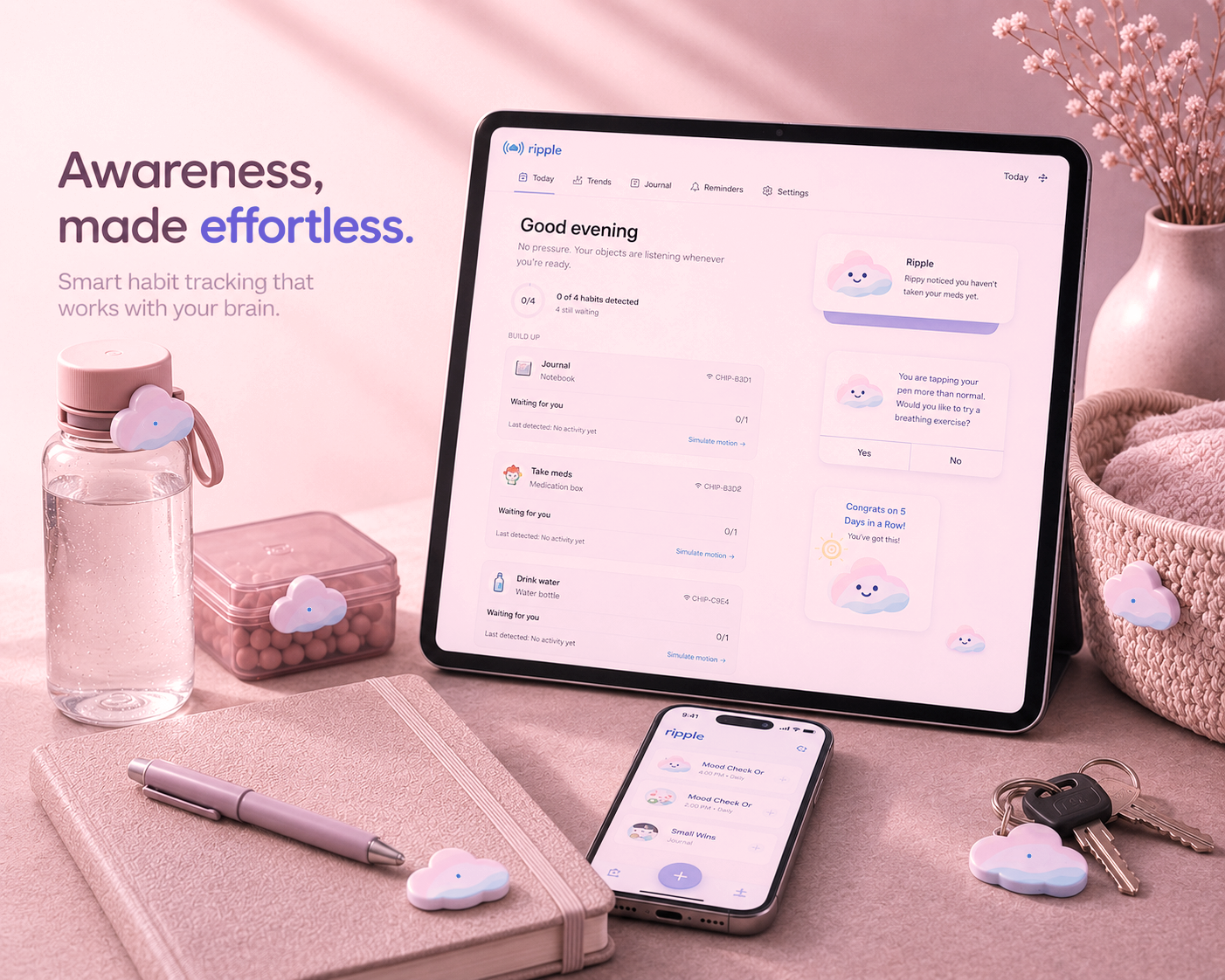
Concepts spanned a smartwatch companion, a sensor-fitted fidget, and a smart ring before landing on a calmer answer: small motion-tracking chips attached to everyday objects — a laundry basket, a toothbrush holder, a medication box — paired with a soft companion app.
Designed two personas, one tone
Mapped Maya (29, anxious professional) and Ethan (12, ADHD middle-schooler) to keep the system honest about discretion, low effort, and gentle feedback. Wrote the voice before the UI so every screen would feel like encouragement, not surveillance.
Shipped a working prototype + landing page
Built a mock app in Lovable to walk users through pairing chips, customizing check-ins, journaling moods, and seeing wins. A separate landing page captured demand and validated the concept with real sign-ups.
The solution
Ripple pairs smart motion-tracking chips with everyday objects to automatically detect when you take action on the habits you're trying to build — or the ones you want to break.
Chips that live where the habit lives
A small adhesive chip sticks to the objects already tied to a behavior — a laundry basket, a toothbrush holder, a pill box, a journal, a pair of running shoes. Movement of the object is the signal, so there's nothing to open, log, or remember. The habit reports itself.
An app that notices, not nags
The companion app turns those signals into gentle awareness: streak-free progress, mood check-ins tied to real moments, and quiet patterns surfaced over time. No red badges, no guilt loops — just a calmer mirror of how the week actually went.
Tools tuned for mood and behavioral disorders
Every interaction is tailored for anxiety, ADHD, and executive dysfunction: low-stakes language, optional reminders, private journaling, and tiny celebrations. The goal is a supportive environment that helps people step out of limiting patterns at their own pace — not a system that performs wellness at them.
Encouragement as the default state
Where most habit apps default to scarcity — missed days, broken streaks, falling behind — Ripple defaults to encouragement. Showing up at all counts. Noticing the pattern counts. The product's job is to make the next small action feel possible.
Outcomes
27
Landing page sign-ups in week one
59%
Reservation rate from intake survey
38
Users in mixed-methods research (survey + interviews)
Reflection
Ripple taught me that the most caring product decision is often subtraction — fewer notifications, fewer taps, fewer reasons to feel like you are failing at being well. Pairing research, hardware concepting, and a shipped prototype in one capstone showed me how far a small team can take an idea when the tone is set first and the tech serves it.
Keep exploring