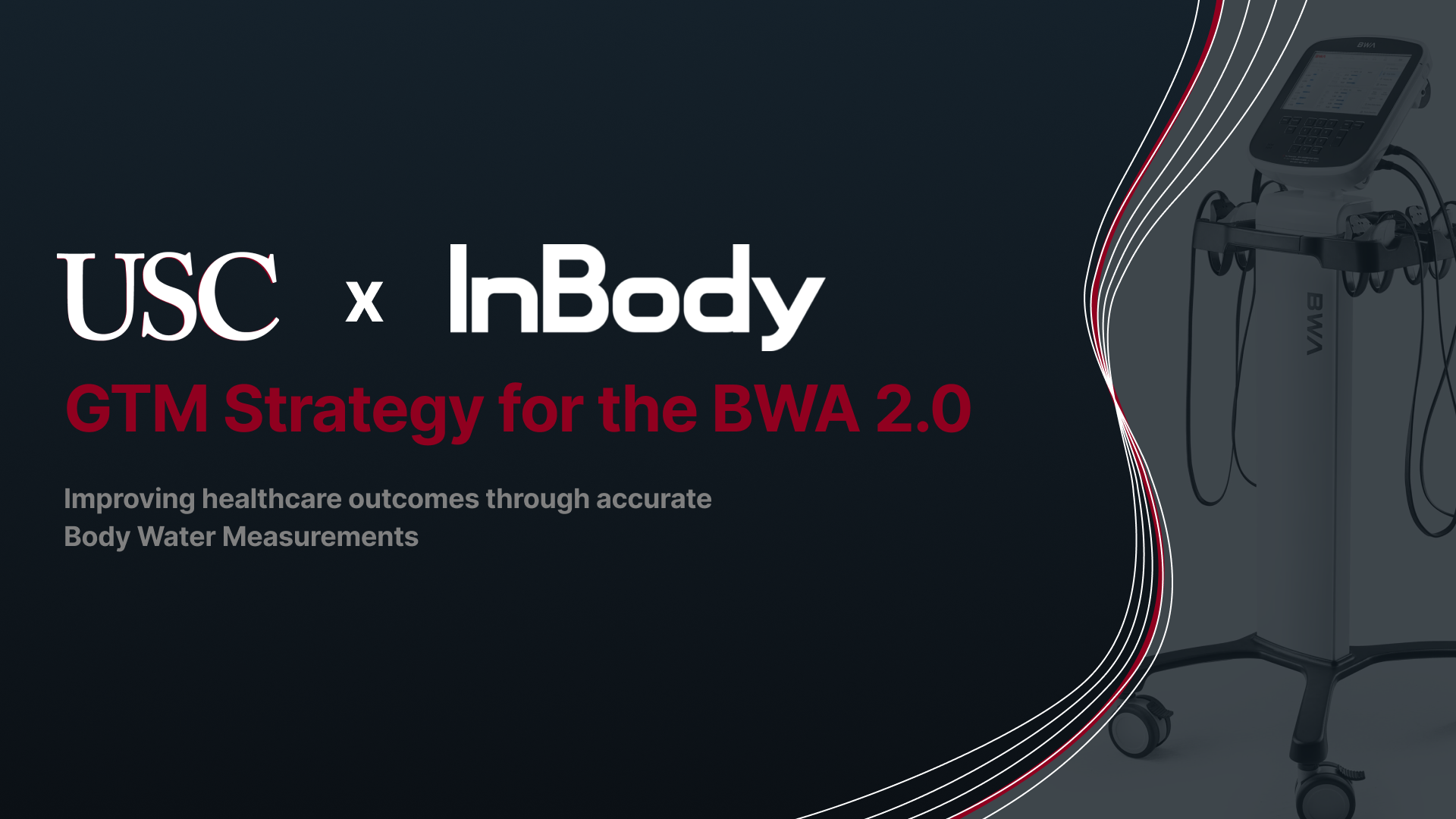
USC × InBody
Translating a medical-grade body water analyzer into a go-to-market strategy for dialysis and physical therapy — through a pivot, a pilot, and 24+ clinics of field research.
- Client
- InBody USA · USC Keck School of Medicine
- Role
- UX Researcher & Strategist (4-person team)
- Year
- 2025
- Duration
- 16 weeks
Context
Dialysis technicians estimate a patient's 'dry weight' largely by trial and error — and getting it wrong means cramping, hospitalizations, and patient anxiety treatment after treatment. InBody's BWA 2.0 promises a faster, objective answer through bioelectrical impedance, but had no validated path into U.S. dialysis or PT clinics. Our team at USC Iovine and Young was brought on to research the opportunity and design a go-to-market strategy.
The problem
How might we validate the BWA 2.0's clinical value in real care settings — and identify the entry points, stakeholders, and messaging that would actually move a medical-grade device into routine use?
Approach
Stood up a real pilot study
Wrote the full pilot protocol and informed consent for 'Investigating the Use of Body Water Analysis to Improve Quality of Care for Hemodialysis Patients' with USC Keck nephrology and DaVita. Completed CITI and HIPAA training, learned the BWA 2.0 hands-on, and aligned on a 3–5 patient observational design comparing BIA against traditional dry-weight estimation.
Pivoted without losing the thread
When IRB and institutional access timelines slipped past the project window, we treated the constraint as a research signal — not a failure — and rebuilt the plan around stakeholder interviews and surveys we could run inside the semester. We kept dialysis in scope and opened a parallel track in physical therapy through Dr. Schroeder and Dr. Yamada at USC.
Visited the clinics, not just the calls
Cold-called 30+ dialysis clinics, visited multiple in person over spring break, and ran demos with DaVita admin and PT faculty. Interviewed patients, technicians, nurses, operators, and providers across both verticals, then triangulated against a published survey distributed to dialysis and PT stakeholders.
Compared two clinical worlds side by side
Mapped the structural differences between privatized dialysis chains and academic PT practices — role division, stages of buy-in, decision-makers, and what 'innovation capacity' actually looks like in each — so recommendations could be tuned to how each setting really adopts new tech.
The solution
A two-vertical go-to-market playbook for the BWA 2.0 — meeting dialysis where bureaucracy is heaviest, and PT where appetite is highest — plus a new pilot proposal for early subclinical lymphedema detection.
Dialysis: enter through the side door
Recommended starting with independent clinics and innovation-driven nephrology groups rather than the large chains where pilots stall. Paired that with a frontline-first activation plan — 10-minute on-site staff wellness demos — so technicians and nurses (the people most enthusiastic about BWA 2.0) become internal champions before procurement gets involved.
Physical therapy: lead with speed and fit
Positioned BWA 2.0 around plug-and-play demos and simplified result interpretation for PT teams already familiar with InBody. Identified lymphedema and oncology rehab as the highest-conviction clinical wedge, with reimbursement and workflow integration called out as the real barriers to plan around.
A new pilot study, scoped and ready
Drafted a follow-on pilot proposal — 'Early detection of subclinical lymphedema using InBody BWA 2.0' — with USC PT faculty, including aims, cohort design, key metrics (detection rate prior to symptom onset, sensitivity/specificity vs. current methods, patient usability), and optional EKG/ultrasound correlation. Now under review.
Messaging tuned for who actually decides
Synthesized findings into role-specific narratives: patient anxiety and cramping for technicians, time-on-floor for operators, evidence and reimbursement for providers, and research/pilot collaboration for academic PT. Compiled a vetted list of innovation-oriented nephrology groups and dialysis-relevant educational partners as concrete outreach targets.
Outcomes
24+
Dialysis and PT clinics engaged through interviews, surveys, and site visits
30+
Clinics cold-called to build the field research pipeline
1
New pilot study proposed with USC PT (subclinical lymphedema detection)
1
InBody 570 purchase secured at Keck Medical Center of USC
Process visuals
Click any image to open the gallery — use arrow keys or the on-screen controls to navigate.
Reflection
This project taught me that in healthcare, the research method has to flex around the institution — not the other way around. Losing our IRB window could have ended the study; instead it forced a more honest answer to InBody's real question, which was never 'does BIA work?' but 'how does this device actually get adopted?' I also learned how differently a privatized chain and an academic clinic hear the same pitch, and why frontline staff — not executives — are usually the people who make a medical device stick.
Keep exploring